
Industrial Fully Automatic Egg Incubator
The 3FFH series fully automatic incubator controls the four conditions that decide incubation — temperature, humidity, egg turning, and fresh air — for commercial hatcheries and breeder operations. Capacities run from 88 to 24,640 chicken eggs per machine, with tray configurations for chicken, turkey, goose, and pigeon eggs.
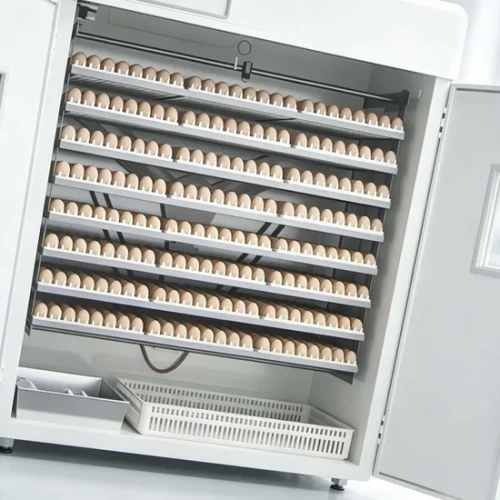
Every function is automatic: the cabinet holds set temperature and humidity, turns the eggs on a timed cycle, circulates air, and alarms on deviation. The operator loads eggs, monitors, and unloads chicks — no daily conditioning work.
Model Range — 88 to 24,640 Chicken Eggs
Each capacity is available in two control variants. Capacities shown as chicken / turkey / goose / pigeon eggs:
Small Cabinet Machines — S Size
| Model | Capacity (chicken/turkey/goose/pigeon) | Power | Dimensions L×W×H (cm) | Layout |
|---|---|---|---|---|
| 3FFH-88HD | 88 / 63 / 32 / — | 150 W | 72×56×80 | 1 layer |
| 3FFH-176HD | 176 / 126 / 64 / — | 150 W | 72×56×90 | 2 layers |
| 3FFH-264HD | 264 / 189 / 96 / 336 | 150 W | 72×56×100 | 3 layers |
| 3FFH-352HD | 352 / 252 / 128 / 448 | 150 W | 72×56×110 | 4 layers |
| 3FFH-440HD | 440 / 315 / 160 / 560 | 150 W | 72×56×120 | 5 layers |
| 3FFH-528HD | 528 / 378 / 192 / — | 200 W | 95×65×100 | 3 layers × 2 columns |
| 3FFH-880HD | 880 / 630 / 320 / — | 200 W | 95×65×120 | 5 layers × 2 columns |
| 3FFH-1056HD | 1,056 / 756 / 384 / 1,344 | 300 W | 120×70×140 | 6 layers × 2 columns |
Medium and Large Machines — M / L Size
| Model | Capacity (chicken/turkey/goose/pigeon) | Power | Dimensions L×W×H (cm) | Layout |
|---|---|---|---|---|
| 3FFH-1584HD | 1,584 / 1,134 / 576 / 2,016 | 400 W | 130×82×140 | 6 layers × 3 columns |
| 3FFH-3168HD | 3,168 / 2,268 / 1,152 / 4,032 | 1,000 W | 170×82×170 | 9 layers × 4 columns |
| 3FFH-5280HD | 5,280 / 3,780 / 1,920 / 6,720 | 1,200 W | 170×105×180 | 12 layers × 5 columns |
| 3FFH-8448HD | 8,448 / 6,048 / 3,072 / — | 1,800 W | 200×180×190 | 12 layers × 2 carts |
| 3FFH-9856HD | 9,856 / 7,056 / 3,584 / 12,544 | 2,200 W | 200×180×210 | 14 layers × 2 carts |
| 3FFH-24640HD | 24,640 / 17,640 / 8,960 / — | 5,000 W | 500×180×225 | 14 layers × 5 carts |
(Data notes: pigeon capacity is missing for several models in the source data — marked “—”, confirm with the factory; packing sizes and per-model weights available on request.)
The machines from 8,448 up work on egg carts — trolleys rolled in and out — rather than fixed trays, which is what makes one-day loading and unloading of a full setting possible at hatchery scale.
What the Machine Controls
Temperature — held automatically at the set point; control accuracy ±0.1 °C (confirm per control system). This is the single most critical incubation parameter.
Humidity — automatic control or an automatic water-addition system, depending on configuration. Humidity setpoints change between setting and hatching days; the machine holds each stage’s setpoint.
Egg turning — programmable timed turning, standard cycle every 2 hours (confirm interval settings). Turning stops automatically in the final days before hatch, as it must.
Ventilation and circulation — fresh air exchange and internal circulation keep CO₂ down and temperature even across the cabinet — corner eggs and center eggs hatch together, not in sequence.
Alarms and panel — digital control panel with alarm functions for out-of-range conditions. An incubator alarm is what protects a setting of thousands of eggs while the operator is elsewhere.
The insulated cabinet holds conditions stable against room-temperature swings — the hatchery room still needs reasonable temperature control, but the machine rides out the daily swings.
Choosing the Right Size
The right model follows your weekly chick output, not a single big number:
- 88–440 eggs (single-column S machines) — entry level: breeder farms hatching their own replacements, village-scale hatcheries, demonstration and training units. Low power draw (150 W) runs on modest electrical supply.
- 528–1,056 eggs (two-column machines) — small commercial hatcheries selling day-old chicks locally, multi-species operations using the tray change between chicken, duck, and pigeon seasons.
- 1,584–5,280 eggs (M machines) — established hatcheries with steady weekly output; machines pair into a rotation so one setting hatches every week.
- 8,448–24,640 eggs (cart machines, L) — full commercial hatcheries; cart handling moves whole settings at once, and the 5-machine layout (24,640) runs as a hatchery production line.
The rotation rule: in single-batch use, one machine hatches one batch per ~21 days — for chicks every week, run 3–4 machines staggered. Machines with multi-batch loading relax this: staggered batches in one cabinet bring the chick output interval down without multiplying machines. Tell us your target weekly output — we calculate machines plus batch schedule, and check the arithmetic with you before you order.
Setter, Hatcher, and the Hatchery Workflow
For larger operations, incubation splits into two machine types: the setter holds the eggs for the first 18 days with turning active; the hatcher takes eggs for the final 3 days, where turning stops and chicks emerge — see our commercial egg hatcher machines for the hatching side. Small single machines combine both functions in one cabinet: eggs set and hatch in the same unit, moved to a separate hatcher only if your workflow requires it.
Small and medium machines in this series are three-in-one: setting, hatching, and brooding in one cabinet — eggs set, hatch, and the chicks are brooded in the same unit before removal. This is the practical configuration for breeder farms and small hatcheries that do not run separate rooms for each stage. Large cart machines stay dedicated to the setter role in a full hatchery workflow — see our commercial egg hatcher machines for the hatching side.
Multi-batch loading: the machines accept eggs in multiple batches — a new setting can go in while earlier batches are still incubating, so one machine produces chicks on a rolling basis instead of one batch per full cycle. This changes the capacity arithmetic from the single-batch rotation rule: one machine with staggered batches delivers chicks more often than a single-batch machine of the same size.
FAQ
What actually determines the hatching rate?
Temperature, humidity, turning, and ventilation — the machine’s job — plus egg fertility, egg storage, egg hygiene, and management practice — your side. The machine holds the conditions precisely; a high rate still requires good hatching eggs and clean handling. We state what the machine controls and how accurately — we do not quote a hatch rate as if it came with the machine.
Can it incubate different poultry species?
Yes. Trays and programs are configured per egg type — chicken, turkey, goose, pigeon, duck. Cycle length, temperature, humidity, and turning are set per species; capacity per machine differs by egg size, as shown in the model table.
What is the difference between HD and HD3 models?
The two variants share capacity and dimensions; the difference is in the control configuration.
How many machines do I need for weekly chick supply?
One machine hatches one batch per cycle (~21 days for chicken). For chicks every week, run 3–4 machines in staggered rotation. Send your target weekly output and we calculate the machine count and rotation plan.
What happens if power fails?
The machine alarms on deviation. For areas with unreliable supply, plan generator backup sized to the machine power draw — from 150 W for the smallest cabinet, which a small generator or backup inverter carries easily.
Do you supply the hatcher as well?
Yes — setter and hatcher machines for full hatchery workflows, or combined-function machines for smaller operations. Tell us your output target and we lay out the set.
Can it run on coal where electricity is unreliable?
Yes — the heating system is dual-use, coal and electricity. The incubation continues on the coal circuit when power is off or when coal is the cheaper fuel on site.
Can I load eggs in batches instead of all at once?
Yes — multiple batches run in one machine on staggered dates, so chicks hatch on a rolling schedule rather than once per full cycle. We confirm the batch schedule against the machine model and your weekly output.