
H-Type Automatic Layer Battery Cage
The H-type automatic layer battery cage is a high-density housing system for commercial egg farms. The H-frame stacks cage rows vertically — from 4 tiers up to 12 in tall houses — so bird capacity is set by house height and floor plan, not by floor area alone. Feeding, drinking, manure removal, and egg collection run automatically on every tier.
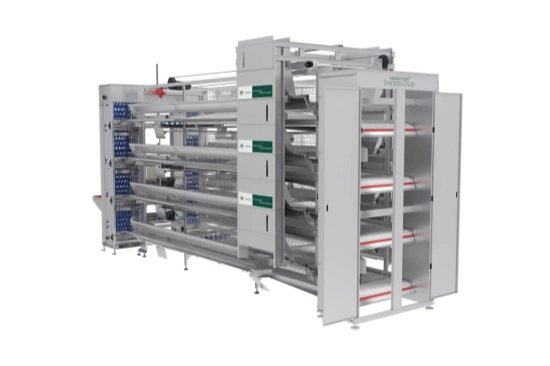
One house on this system typically replaces several floor-rearing houses in bird capacity, with a fraction of the daily labor. Configuration follows the house: bird number, dimensions, tier count, manure method, local welfare requirements, and egg collection arrangement.
Key Features
- 4 to 12 tiers — vertical capacity for tall houses; we set the tier count against your house height.
- Hot-dip galvanized cage structure — service life around 20 years under normal farm conditions; the coating specification is confirmed for humid or coastal sites.
- Automatic feeding line on every tier.
- Nipple drinking line with pressure regulation per tier row.
- Manure belt removal under each tier — manure leaves the house dry, cutting ammonia and litter handling.
- Automatic egg collection — longitudinal egg belts per tier, delivering to a cross or central conveyor.
- Modular cage sets — a full house is built from standard cage modules, so capacity scales in defined steps.
- Project-based layout — cage rows, aisles, and head-ends are designed from your house drawings, not from a catalog page.
Cage Models
Three standard cage models cover different bird sizes and regional preferences. Each “set” is one cage unit; a full house repeats sets along the rows:
| Cage size L×W×H (mm) | Doors per cage | Birds per door | Birds per set | Area per bird (cm²) | Length with frame (mm) | Installed width incl. feeder (mm) | Installed height incl. feeder (mm) |
|---|---|---|---|---|---|---|---|
| 1950×450×410 | 5 | 4 | 160 | 438.75 | 2,000 | 1,760 | 3,035 |
| 1800×600×430 | 4 | 6 | 192 | 450 | 1,850 | 2,010 | 3,210 |
| 1200×625×480 | 4 | 8–9 | 128 | 469 | — | 2,134 | 3,424 |
Installed height figures above are for the standard tier arrangement; taller configurations scale with the tier count. Area per bird is cage floor area divided by bird count — the welfare figure most markets regulate. Tell us your market’s local requirements and we match the cage model and bird count to them.
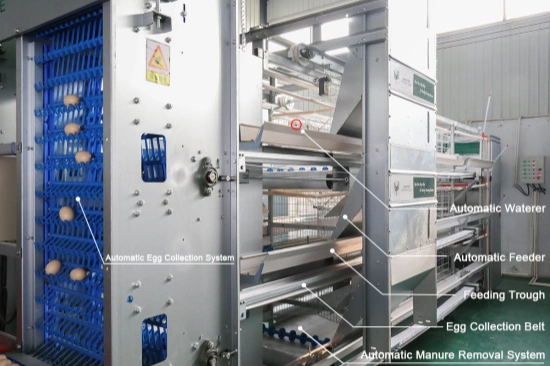
Advantage Of H Type Fully Automatic Chicken Equipment
2 to 5 Times Raising Quantity
- 2 to 5 times higher capacity compared to A Type.
- Suggested chicken capacity/house> 30000 birds.
- Ideally suited for large-scale chicken farms.
Only one person manages
- Automatic feeding, drinking, and egg collecting.
- Intelligent control environment
- Smart warning of environmental control problems.
Optimal Raising Results
- Laying rates min 96%.
- Eggs Damaging Rate does not exceed 0. 3%.
- 20 years service life.
Upgraded to smart farm
- Integrate all data of the farm.
- Smart control the whole farm.
- A timely reminder of environmental changes.
H-Type vs A-Type Layer Cages
Both are cage systems — the difference is the frame and what it lets you automate. A-type cages rest on an A-shaped support in steps; H-type stacks tiers vertically on an H-frame:
| Factor | H-Type (Automatic) | A-Type (Manual / Semi-Auto) |
|---|---|---|
| Structure | Vertical H-frame, 4–12 tiers | Stepped A-frame, typically 3–4 tiers |
| Bird density per m² of house | Higher — capacity grows with height | Moderate — capped by tier count |
| Automation | Full: feeding, drinking, manure belts, egg collection | Often manual egg collection and manure cleaning |
| Manure handling | Belt per tier — dry manure, lower in-house ammonia | Scraper or pit — wetter manure |
| House height requirement | Tall house needed for high tier counts | Standard house height |
| Initial investment | Higher | Lower |
| Daily labor | Minimal — monitoring and maintenance | Higher — manual collection and cleaning |
| Best for | Commercial farms from tens of thousands of birds upward | Smaller farms, starter operations, retrofit buildings |
The decision usually comes down to scale and house height. If you already have a tall building or are constructing new, H-type turns that height into capacity and pays back the automation through labor savings. If the building exists and is low, A-type fits it. Send your house drawings and bird target — we tell you which fits, honestly, including when the answer is A-type.
The Automation on the Cage
Feeding — automatic feeding lines run the cage rows on every tier, delivering feed to the troughs without manual filling. The exact drive arrangement (traveling hopper or chain) is per configuration.
Drinking — nipple drinking lines with per-row pressure regulation, the same line components as our poultry drinking line system. Height is set at delivery and stays fixed for adult layers.
Manure removal — a PP manure belt runs under each cage tier and conveys manure to the house end. Compared with scraper-and-pit systems, belt removal delivers drier manure and lower in-house ammonia, and the drier output is easier to store or sell as fertilizer. Belt width and drive are configured to the row length.
Egg collection — longitudinal egg belts carry eggs from each tier to a cross conveyor at the row end, and from there to a central collection point or directly into an egg grading machine. The collection arrangement is set by house layout — single-end, cross-house, or central collection room.
FAQ
Can the cage system include automatic egg collection?
Yes. Longitudinal egg belts on each tier, cross conveyors, central collection, and grading equipment — configured to the house layout. See the layout we return with your quotation.
Can the number of tiers be customized?
Yes — from 4 to 12 tiers. The limit is your house height and structure, plus local regulations. We confirm the maximum tier count against the drawings.
How many birds fit in my house?
Send the house dimensions (length × width × height, with column spacing) and we return the layout with total capacity. Same floor area can hold very different bird numbers at different tier counts.
What about welfare regulations in my market?
Cage requirements differ by country — space per bird, configuration, and whether cages are permitted at all. Tell us the destination market and its requirements, and we match the cage model and bird count to comply.
How does manure handling work?
A belt under each tier conveys manure to the house end. Drier than pit systems, lower ammonia in the house, and the output stores or sells as fertilizer more easily.
What is the delivery and installation time?
Production follows house readiness. A full-house system ships in multiple containers with installation drawings; schedule depends on capacity and project queue — we confirm with the order.
How long do the cages last?
Around 20 years under normal farm conditions, on hot-dip galvanized steel. Heavier coating specs are available for corrosive sites.