
Main Feed Delivery Auger System
Automatic feed delivery auger system for poultry and pig farms — 12 standard auger sizes from 36 to 100 mm, configured to your conveying distance, house layout, and feeding lines.
The main feed delivery auger system transfers dry feed from a feed silo or central hopper to the feeding lines inside the poultry or pig house. It is the conveying section between feed storage and the feeding equipment:
Feed Silo → Silo Boot → Auger Line → Drop Outlets → House Feeding System
Each line is configured against feed type, conveying distance, house length, required capacity, power supply, and the number of feeding lines.
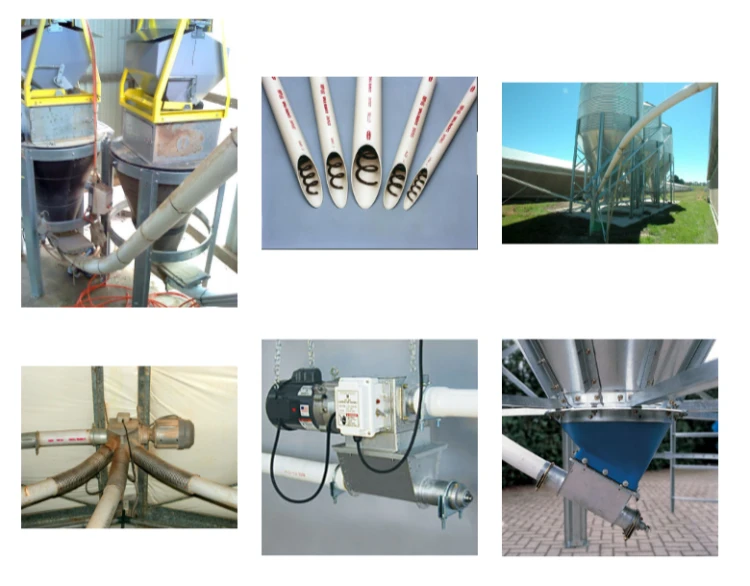
Product Overview
The system uses a rotating helical auger spring inside a conveying pipe. As the motor turns the auger, feed moves continuously through the pipe toward the house. Drop outlets along the line release feed into pans, day hoppers, or chain feeders.
For different farm layouts, we supply single or twin silo boots, different auger and pipe combinations, feed level sensors, end controls, flexible connections, and support components. Configurations cover single-house and multi-house installations.
Key Features
- 12 standard auger specifications — outer diameters from 36 to 100 mm; custom sizes produced to order
- Helical auger spring conveying — continuous dry-feed transfer with minimal separation for pellet and crumble
- Single, twin, and straight silo boots — one silo can feed one or two auger lines
- Feed level sensors and end controls — the line runs only when the downstream system calls for feed
- Motor and gearbox sized to line length and capacity — voltage and frequency set to your local standard
- Drop outlets and flexible connections — positioned along the line to fill your feeding equipment
- Multi-house layouts — branch lines and independent control points for each house
- Knock-down supply — components packed for containerized export
Technical Specifications
The following are our standard production sizes. We confirm the final selection against feed type, conveying distance, and required capacity.
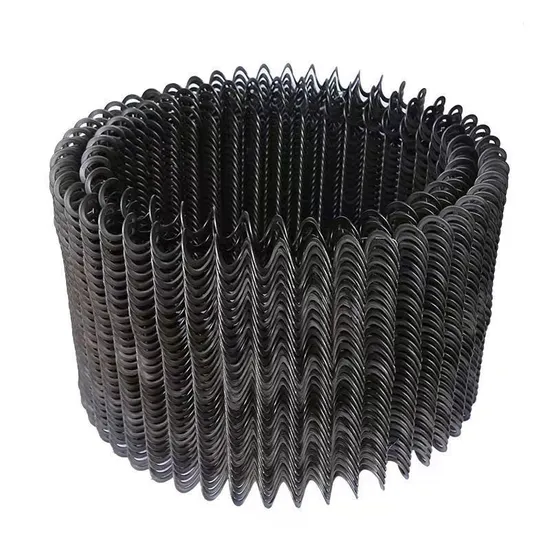
| Outer Diameter | Inner Diameter | Pitch | Strip Section |
|---|---|---|---|
| 36 mm | 20 mm | 32 mm | 4 × 7.9 mm |
| 36 mm | 20 mm | 40 mm | 4 × 7.9 mm |
| 36 mm | 20 mm | 50 mm | 4 × 7.9 mm |
| 39 mm | 20 mm | 44 mm | 4 × 9.5 mm |
| 42 mm | 22 mm | 58 mm | 4 × 9.5 mm |
| 60 mm | 37 mm | 45 mm | 4.2 × 11.5 mm |
| 60 mm | 37 mm | 60 mm | 4.2 × 11.5 mm |
| 70 mm | 43 mm | 67 mm | 4.4 × 13.5 mm |
| 75 mm | 48 mm | 75 mm | 4.4 × 13.5 mm |
| 80 mm | 53 mm | 68 mm | 4.4 × 13.5 mm |
| 90 mm | 63 mm | 80 mm | 4.4 × 13.5 mm |
| 100 mm | 73 mm | 80 mm | 4.4 × 13.5 mm |
Custom auger dimensions can be produced to order.
Common Configurations
| Feeding Application | Pipe Diameter | Auger Diameter |
|---|---|---|
| Poultry feeding line | 45 mm | 36 mm |
| Pig feeding line | 75 mm | 60 mm |
| Main feed filling line | 90 mm | 70 mm |
These combinations are examples, not fixed standards. Motor power, conveying capacity, and maximum line length depend on the actual installation — we calculate them from your house layout.
System Components
- Feed silo outlet or receiving hopper
- Silo boot — single, twin, or straight
- Auger conveying pipe
- Helical auger spring
- Drive motor and gearbox
- Feed level sensor
- Drop outlets and flexible connections
- End control or shut-off device
- Suspension and support components
Silo Boot Options
The silo boot connects the feed silo to the auger line and determines how feed enters the system.
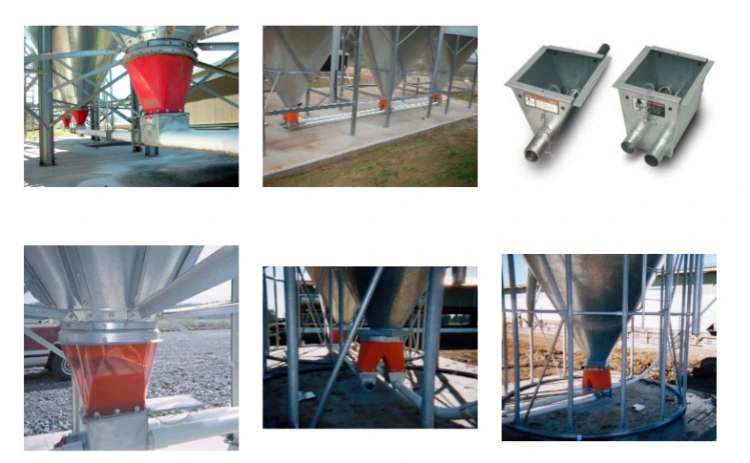
Single boot — one silo, one main auger line. The standard configuration for single-line installations.
Twin boot — one silo feeding two auger lines. Used where a single silo supplies two houses or two conveying routes; we plan the control sequence around the silo outlet position.
Straight boot — for layouts where the silo outlet and auger line align at the required height and direction. This simplifies the connection to the horizontal or inclined conveying section.
Auger sizing starts at the silo: we confirm outlet height and discharge configuration against your feed silo — galvanized steel or fiberglass — before laying out the line.
How the System Works
Feed enters through the silo outlet or receiving hopper. The drive motor rotates the helical auger spring, and feed travels through the pipe to the drop outlets, where it enters the house feeding system. Level sensors stop and start the line automatically according to feed demand — feed arrives when the pans or hoppers call for it, not on a fixed timer.
For multi-house projects, we arrange separate branches and control points so each house draws feed independently.
Auger or Chain Feeding?
Both systems deliver feed from silo to house. The choice comes down to feed type and line layout:
| Factor | Auger Feeding | Chain Feeding |
|---|---|---|
| Feed type | Pellet and crumble | Mash, pellet, and crumble |
| Layout | Shorter, straighter runs | Longer runs and complex layouts |
| Feed separation | Minimal — feed moves as a column | Some separation on long horizontal runs |
| System cost | Lower for standard lines | Higher — heavy-duty chain and corner components |
| Typical use | Poultry feeding lines, silo-to-house filling | Long house feed lines, mash feeding |
For a new project, we select the feeding method together with the house layout and the downstream equipment — not by auger size alone.
Selecting the Auger Specification
There is no single auger size that suits every farm. Two lines handling the same feed can need different specifications:
- A short poultry feeding line fills a small-diameter pipe frequently — a 36 mm auger in 45 mm pipe covers this duty.
- A main filling line moving bulk feed to day hoppers carries more load — 70 mm auger in 90 mm pipe at this duty.
- Longer conveying distances and inclined sections increase the load on the auger and motor, so we step up the specification accordingly.
This is why we quote from your house layout rather than a catalogue. The full input list is in the design section below.
Applications
- Broiler houses with automatic pan feeding systems
- Layer and breeder houses with pan or chain feeding systems
- Pig farms with dry-feed delivery lines
- Multi-house farms supplied from central silos, each house on an independent branch
- Feed filling lines from silos to day hoppers
The main auger connects to pan feeders, day hoppers, and chain feeding lines through drop outlets sized to your equipment.
Export Supply and Packing
The system ships in knock-down form for containerized export. A typical shipment includes auger springs, conveying pipes, silo boots, drive motors and gearboxes, drop outlets, sensors, end controls, flexible connections, and suspension components. For multi-house projects, we prepare the equipment list and packing arrangement against the number of houses and lines.
Information Required for Project Design
Send us the following and we will confirm the auger size, pipe, motor rating, boot type, outlet positions, and control arrangement:
- Number of houses, house length and width
- Silo position, capacity, and outlet height
- Conveying route — distance, horizontal and inclined sections
- Number of feeding lines and downstream equipment (pans, hoppers, chain)
- Feed type — pellet, crumble, or mash
- Daily feed consumption or required delivery capacity
- Local voltage and frequency
- Destination country or port
FAQ
Can the auger system be connected to a galvanized feed silo?
Yes. We match the silo outlet, boot, pipe, and auger arrangement during project design. The same applies to fiberglass silos — confirm the outlet size when ordering.
How is the conveying capacity determined?
Not by motor power alone. Feed type, auger specification, conveying distance, pipe arrangement, and required filling time all affect capacity. We calculate it from your complete house layout.
Which auger and pipe size should I use?
Common configurations: 36 mm auger in 45 mm pipe for poultry lines, 60 mm in 75 mm for pig lines, and 70 mm in 90 mm for main filling lines. We confirm the final size against your conveying route and capacity.
Can one silo supply multiple poultry houses?
Yes. Twin boots and separate auger lines let one silo feed two routes. For more houses, we plan the branch connections and control sequence together.
Can it work with an automatic pan feeding system?
Yes. Drop outlets transfer feed from the main line into the pan system, day hoppers, or chain feeders.
Is the auger spring a wear part?
Yes — the helical spring is the main wearing component. We supply spare springs with the system; confirm quantities when requesting a quotation.
Can you supply custom auger sizes?
Yes. The table above lists standard production sizes; other dimensions are produced to order.