Industrial Diesel Space Heater
The industrial diesel space heater delivers rapid hot-air heating for poultry houses, livestock buildings, workshops, and warehouses. Running on diesel or kerosene, the series spans 10 to 70 kW with airflow from 300 to 2,000 m³/h — covering roughly 80 to 800 m² per unit depending on model and building insulation.
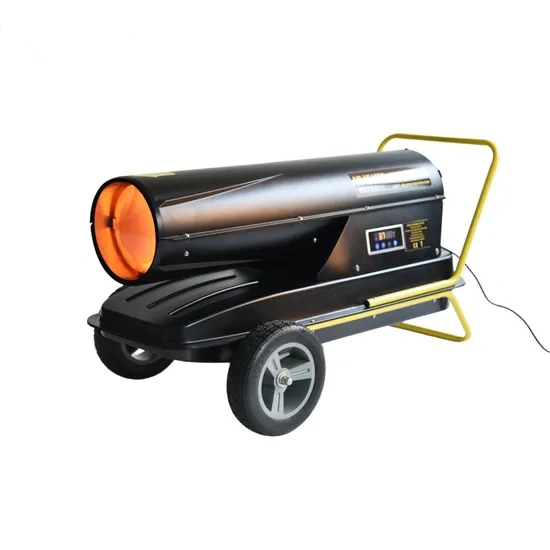
It is the workhorse choice for cold-season heating: fast warm-up, large airflow throw, automatic thermostat control, and a fuel supply that is available almost everywhere — relevant on farms with no natural gas line.
Key Features
- 10–70 kW output range — one series covers a single brooding room through a full-length house.
- 300–2,000 m³/h airflow — pushes warm air the length of the building instead of pooling heat at one end.
- Runs on diesel or kerosene — fuel is available in rural areas of every market; no gas line needed.
- Electronic ignition with automatic thermostat — set the temperature; the burner cycles to hold it. No pilot flame, no daily adjustment.
- Overheat and flame-out protection — the burner shuts down on excessive temperature or flame loss.
- Portable, wheeled frame — moved between houses or positioned where the heat is needed; fixed installation is also possible.
- 220 V / 110 V / 380 V options — matched to your market before ordering.
Technical Specifications — Series Range
| Item | Specification |
|---|---|
| Fuel | Diesel / kerosene |
| Heating capacity | 10–70 kW (multiple models) |
| Airflow | 300–2,000 m³/h |
| Heating area | 80–800 m² per unit |
| Fuel consumption | 0.8–6.5 L/h |
| Voltage | 220 V / 110 V / 380 V |
| Ignition | Electronic |
| Temperature control | Automatic thermostat |
| Safety protection | Overheat shut-off, flame-out protection |
| Mobility | Portable with wheels; fixed installation possible |
| Combustion type | Direct-fired / indirect-fired — confirm per model |
The ranges above span the series. Each model has its own kW, airflow, consumption, and coverage figures — send your building size and we quote the exact model, not the range.
How It Heats
The heater draws fuel from its onboard tank, ignites electronically, and burns in a combustion chamber. A fan pushes air across the heat exchanger surface and throws warm air in a directed stream across the building. The thermostat cycles the burner to hold the set temperature.
Two combustion configurations exist in this class of heater, and the difference matters for livestock buildings:
Direct-fired — the combustion gases mix with the heated air. Nearly all the fuel energy enters the room, so heat output per liter of fuel is high. The trade-off: combustion products are in the air the birds breathe, so the minimum ventilation rate must cover combustion as well as the animals. Standard practice on many farms — but it must be a deliberate ventilation design, not an accident.
Indirect-fired — combustion exhausts through a separate flue to the outside, and only clean heated air enters the building. Slightly lower fuel efficiency, but no combustion products in the house.
Confirm the configuration for your model before ordering — we state it on every quotation. (Configuration of this series to be confirmed.)
Sizing
Heater selection depends on building volume, insulation level, ventilation rate, outside temperature, and target inside temperature — not on floor area alone. Two rules we design against:
- Poultry houses are ventilated buildings — the heater must replace the heat the ventilation removes, which is why a broiler house needs more kW per m² than a sealed warehouse.
- One large heater or several smaller ones — several units spread the throw and even out the temperature profile along the house; one unit concentrates heat near itself.
Send house dimensions, insulation, winter temperatures, and minimum ventilation plan. We calculate the required kW and model count.
Diesel Heater or Gas Brooder?
We supply both. They solve different problems:
| Factor | Diesel Hot Air Heater | Infrared Gas Brooder |
|---|---|---|
| Heat delivery | Warm air, whole-house volume | Radiant warmth on the brooding circle |
| What gets warm first | The air, then everything in it | The chicks and the litter directly |
| Fuel | Diesel / kerosene | LPG / natural gas |
| Best stage | Whole-house temperature hold, grow-out, workshops | First-week brooding, spot heating |
| Air quality | Direct-fired adds combustion products to the air (see above) | Radiant heat with flueless gas burning — ventilation rules also apply |
| Best for | Farms without gas supply, cold regions, multi-purpose use | Brooding-focused farms with LPG available |
Many cold-climate farms run both: gas brooders for the brooding weeks, diesel hot air to hold the house temperature through grow-out.
Safety
- Overheat protection shuts the burner down before components reach dangerous temperature.
- Flame-out protection cuts fuel if the flame is lost.
- Ventilation is part of the heating design, not an afterthought — combustion consumes oxygen and produces gases. We confirm the minimum ventilation rate against the heater capacity and bird numbers.
- Refuel only when the unit is off and cooled. Follow the manual for fuel specification and storage.
Applications
- Poultry houses — broiler, layer, breeder — cold-season whole-house heating
- Pig, calf, and sheep houses in winter
- Workshops, warehouses, and construction sites — the same heater serves both farm and non-farm duty
- Backup heating where the primary system is gas or biomass
FAQ
Is this heater safe for a poultry house with birds inside?
Yes, with the ventilation designed for it. The heater has overheat and flame-out protection; the ventilation plan must cover combustion along with the birds’ own requirements. We confirm the minimum ventilation rate with the sizing calculation.
What is the difference between direct-fired and indirect-fired?
Direct-fired mixes combustion gases into the heated air — maximum fuel efficiency, but the ventilation must account for it. Indirect-fired exhausts combustion outside and delivers clean heated air. We state the configuration on every quotation.
How much fuel does it use per day?
Consumption is 0.8–6.5 L/h depending on model, at full output. With thermostat cycling, actual daily use depends on your climate, insulation, and target temperature — we estimate it against your house data.
Can I move it between houses?
Yes — the unit is portable on wheels, and fixed installation is also possible. Models with fuel tanks and duct connections are matched to your use.
Which voltage do I need?
220 V, 110 V, and 380 V options cover standard supplies in our export markets. Confirm your local voltage when requesting a quote.
Can it run on kerosene?
Yes — diesel or kerosene, by model. Kerosene is common in markets where diesel gels in winter.