
7090/5090 Evaporative Cooling Pad
The 7090/5090/6090 evaporative cooling pad lowers the temperature of incoming air in poultry and pig houses. Water spreads over the wet cellulose surface while exhaust fans pull outside air through the pad — the air is cooled by evaporation before it enters the house.
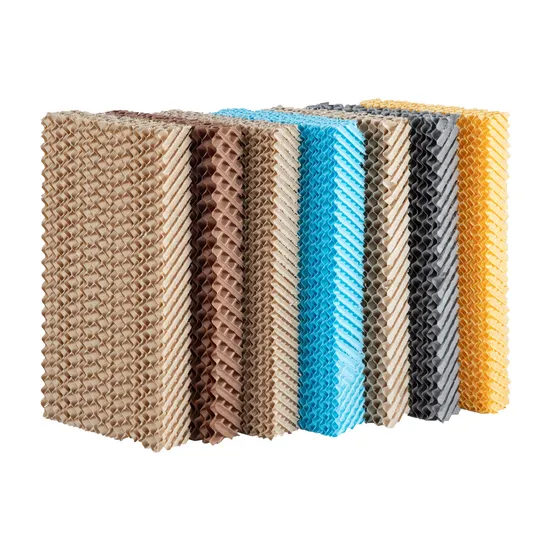
The cooling wall is supplied complete: pads, aluminum or galvanized frame, water tank, circulation pump, distribution pipe, return pipe, and control accessories. Pad type and area are matched to your fans, house, and climate.
7090 or 5090?
The codes describe the pad geometry: the first digits give the flute pitch in millimeters, the last two the flute angle. 7090 has 7 mm flutes; 5090 has 5 mm flutes — both at 90°.
| Factor | 7090 | 6090 | 5090 |
|---|---|---|---|
| Flute pitch | 7 mm | 6 mm | 5 mm |
| Wet surface area | Lowest of the three | Middle | Highest |
| Pressure drop | Lowest | Middle | Highest |
| Dust tolerance | Widest channels resist clogging | Middle | Clogs soonest in dusty conditions |
| Best for | Dusty sites, limited fan reserve | Balanced choice for standard tunnel houses | Maximum cooling where fan capacity allows |
Both types come in 100, 150, and 200 mm thickness. Thicker pads give more contact time and cooling but add pressure drop your fans must overcome — 100 mm suits moderate climates with limited fan reserve; 150 mm is the standard choice for hot-climate tunnel houses; 200 mm is for maximum cooling where fan capacity allows. We select type and thickness together with the fan calculation, not separately.
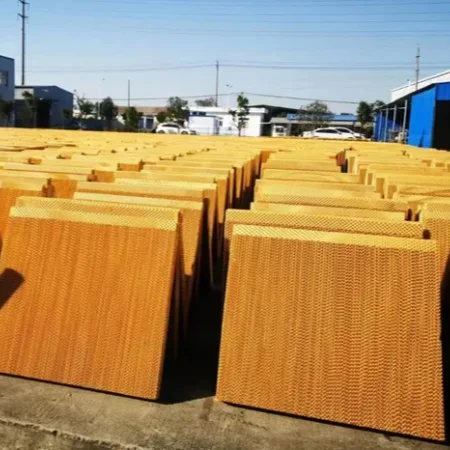
The Complete Cooling Wall
| Component | Function |
|---|---|
| Cooling pads | Corrugated, resin-impregnated cellulose; the sheets are bonded so the paper holds its shape and does not rot when permanently wet |
| Frame | Aluminum alloy, or galvanized steel — aluminum preferred for coastal and permanently wet sites |
| Water tank | Bottom reservoir, sized to the wall |
| Circulation pump | Lifts water to the distribution pipe |
| Distribution pipe | Spreads water evenly along the top of the pads |
| Return gutter and pipe | Collects unevaporated water back to the tank |
| Filter and controls | Keeps debris out of the loop; ties operation to the environment controller |
Pads are modular sections — a damaged section is replaced individually without dismantling the wall.
How the Cooling Works
- The circulation pump lifts water from the tank to the distribution pipe along the top of the wall. Water flows down the corrugated pad surface.
- Exhaust fans at the far end of the house pull outside air through the wet pad.
- Part of the water evaporates, and the heat for evaporation is taken from the air itself. The air leaves the pad cooler and more humid, then travels the house length at tunnel velocity.
The water that does not evaporate keeps washing the pad surface — removing dust — and drains back through the gutter system to the pump station. The only power the cooling wall itself consumes is the circulation pump; the fans are already running for ventilation.
The drier the outside air, the larger the temperature drop. In arid climates the pad delivers its maximum cooling; as ambient humidity rises, the achievable drop shrinks. We estimate both the cooling result and the water consumption from your local climate data — dry regions cool hardest but use more water.
Sizing — What We Calculate
Pad area must match fan quantity and airflow, house cross-section, local temperature and humidity, and target air speed. Two failure modes we design against:
- Air speed through the pad too high — water droplets carry through into the house.
- Air speed too low — evaporation efficiency drops and the wall underperforms.
Send house dimensions and summer climate data. We confirm the pad area, type, thickness, and water consumption estimate — and if you are buying fans at the same time, we size the pads and fans as one system.
Operation in Humid Climates
Above roughly 80% relative humidity, evaporative efficiency falls — there is little dry air left to work with. In tropical regions the cooling wall is still useful: it cuts the peak temperature on all but the wettest days, and the remaining benefit comes from tunnel air speed itself, which cools birds directly. We state the expected performance for your humidity range before you order — not a single figure that pretends to fit every climate.
Maintenance
- Keep the tank covered and shaded; manage water quality per the treatment guidance supplied with the system — scale and algae are the main threats to pad life.
- Inspect the distribution pipe and gutter for blockage between flocks.
- Flush the tank and loop during house downtime.
- Replace individual pad sections when they sag, scale up, or lose rigidity — not the whole wall.
FAQ
What is the difference between 7090 and 5090 pads?
Flute geometry: 7090 has 7 mm flutes, 5090 has 5 mm, both at 90°. The 5 mm flute packs more wet surface into the same face for stronger cooling, at a higher pressure drop; the 7 mm flute passes air more freely and tolerates dust better. Selection depends on your fan capacity and site conditions — we match both together.
Can you supply the complete cooling wall?
Yes. Pads, frame, water tank, circulation pump, distribution pipe, return pipe, filter, and control components as one set — or replacement pads only for an existing wall.
How much cooling will I actually get?
That depends on your ambient humidity. In dry air the temperature drop is large; in humid air it is limited. Send your summer temperature and humidity figures and we state the expected performance and water consumption for your site before you order.
Does it still work in tropical humidity?
Efficiency drops above roughly 80% relative humidity. The wall still cuts peak temperatures on most days, and tunnel air speed provides direct bird cooling on the wettest ones. We do not quote a single efficiency figure for every climate — we quote yours.
How long do the pads last?
Pad life depends on water quality, dust load, and maintenance. Pads are modular — sections are replaced individually as they wear, not as a full wall. We confirm expected service life for your water and dust conditions.